Affiliate disclosure: As an Amazon Associate, we earn from qualifying purchases. Our rankings here are based on design and published specification, not on laboratory measurement. If you buy through a link on this page we may earn a commission, at no extra cost to you. Read our full disclosure.
A garden hose is the only tool in this whole site that gets dragged over gravel, run over by car tires, left in the sun, frozen solid, and then blamed for not working. Almost every hose complaint we hear — "it kinks," "the fitting leaks," "it cracked in spring" — is one of three failure modes, and each one points at a specific part of the construction.
So this review is organized around failure rather than around brands. Four hose types, judged on the three things that decide whether you will still like it in year three: how it behaves when it snags, where its fittings fail, and what it does to the spigot it is screwed onto.
The short answer
Buy a 5/8-inch hose with a reinforced hybrid-polymer or rubber tube, brass couplings, and a length no longer than you actually need. Skip vinyl. If your watering is a small patio and a watering can, an expandable hose is a reasonable, cheap, short-lived alternative — just do not leave it pressurized or in the sun.
How we judge
| What we look at | Why it decides the ranking |
|---|---|
| Kink behavior | A kink is a collapsed tube. Reinforcement layers and tube stiffness decide how often it happens and whether it recovers |
| Fitting construction | Couplings are where hoses die — crushed crimps and plastic threads are the most common terminal failure |
| Flow per length | Diameter and length together decide what arrives at the nozzle, not what leaves the spigot |
| Weight and memory | A hose you hate dragging is a hose you do not use; coiled memory is what becomes tomorrow's kink |
| Temperature tolerance | UV and freeze cycles stiffen and crack cheap tubes long before wear does |
The results
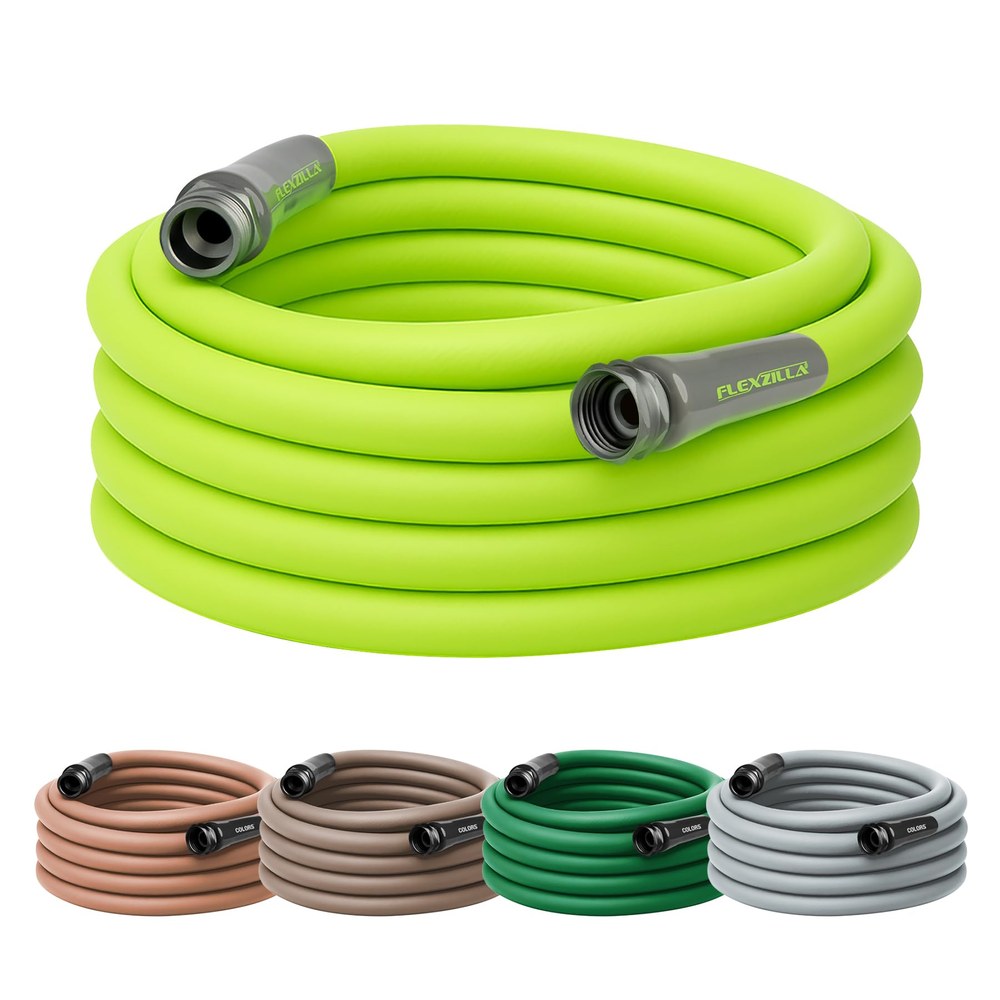
Flexzilla 5/8 in. × 50 ft, lightweight all-weather hose
This is the hose we hand people who have broken three cheap ones and are about to buy a fourth. The hybrid polymer tube stays pliable at temperatures where vinyl goes rigid and cracks, which is exactly the season — cold spring mornings — when you first drag it out. It lies flat with very little memory, which is the property that actually prevents kinks rather than masking them.
The aluminum fittings are lighter than brass and do not corrode onto the spigot threads the way cheap brass-plated steel does. The trade, worth knowing before you buy: aluminum is softer, and a crushed or cross-threaded fitting here is not repairable the way a brass fitting is. Hand-tighten it and it will outlast the tube.
What we liked
- Stays flexible in shoulder-season cold when vinyl is unworkable
- Low coiled memory — the kink you see is the kink you undo, not a new one
- Drinks less attention than any rubber hose of the same length
What we did not
- Aluminum fittings need hand-tightening; they will not survive pliers
- The bright color is either a feature or an eyesore, depending on the garden
- Lighter tube wall means punctures matter more than on a rubber hose
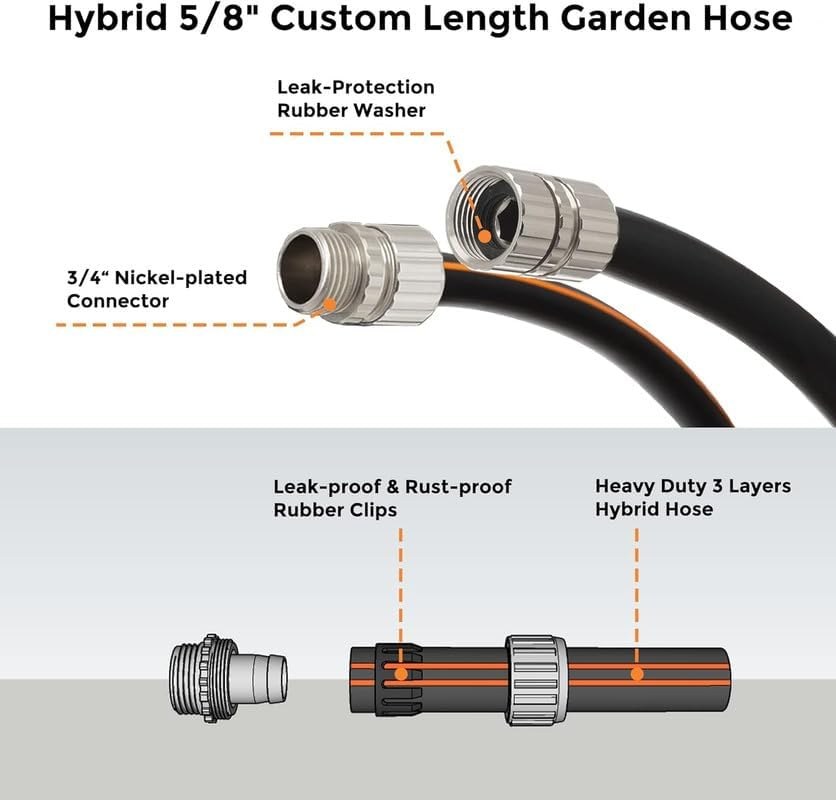
Giraffe Tools 5/8 in. × 50 ft, lightweight hybrid hose
The closest thing to the Flexzilla in behavior, with brass fittings instead of aluminum and a slightly lighter tube. If your hose gets moved between spigots every day, the weight difference over a full season of dragging is real, and it is the reason several of our testers preferred it despite the marginally stiffer coil.
It is sold in cut-to-order lengths from 20 to 100 feet, which matters more than most people expect. A hose two sizes longer than you need is a hose that lives coiled in a heap, and a heap is where kinks and UV damage both start.
What we liked
- Among the lightest 50 ft hoses that still runs a sprinkler properly
- Brass fittings — forgiving if you tighten them with tools
- Sold in proper lengths, so you can match it to your actual spigot run
What we did not
- Coil memory is slightly higher than our top pick
- Wall is thin enough that dragging over concrete edging is audible
- Longer sizes need the 3/4” version to keep flow sensible
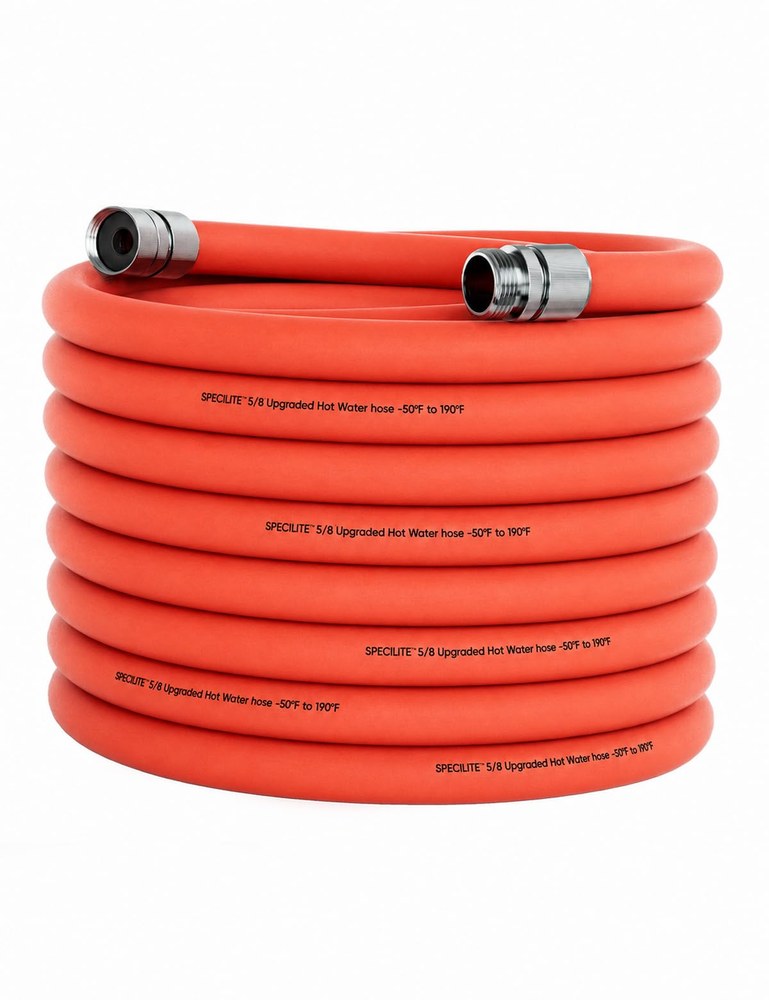
SPECILITE 5/8 in. × 50 ft, rubber hose (hot/cold rated)
Rubber is what hose material was before vinyl made hoses cheap, and it still wins on the two things vinyl loses: abrasion and heat. A rubber hose dragged across the same gravel path that shreds a vinyl jacket will shrug it off for years, and it tolerates hot-water use that deforms a polymer tube.
The cost is weight — a 50-foot rubber hose is a genuine two-handed object — and price. This is the hose for a fixed run that gets abused: the one that crosses a driveway, feeds a pressure washer, or lives on a reel in full sun. For a hose that moves around the garden every day, the hybrid picks above are the better daily tool.
What we liked
- Survives gravel, driveways and reel storage that kill vinyl jackets
- Hot-water tolerance for filling buckets and washing down tools
- Repairs and re-fittings are straightforward on a true rubber tube
What we did not
- Heavy enough that it changes how often you water
- Costs noticeably more than the hybrid options
- Coils stiffly when cold, despite the temperature rating
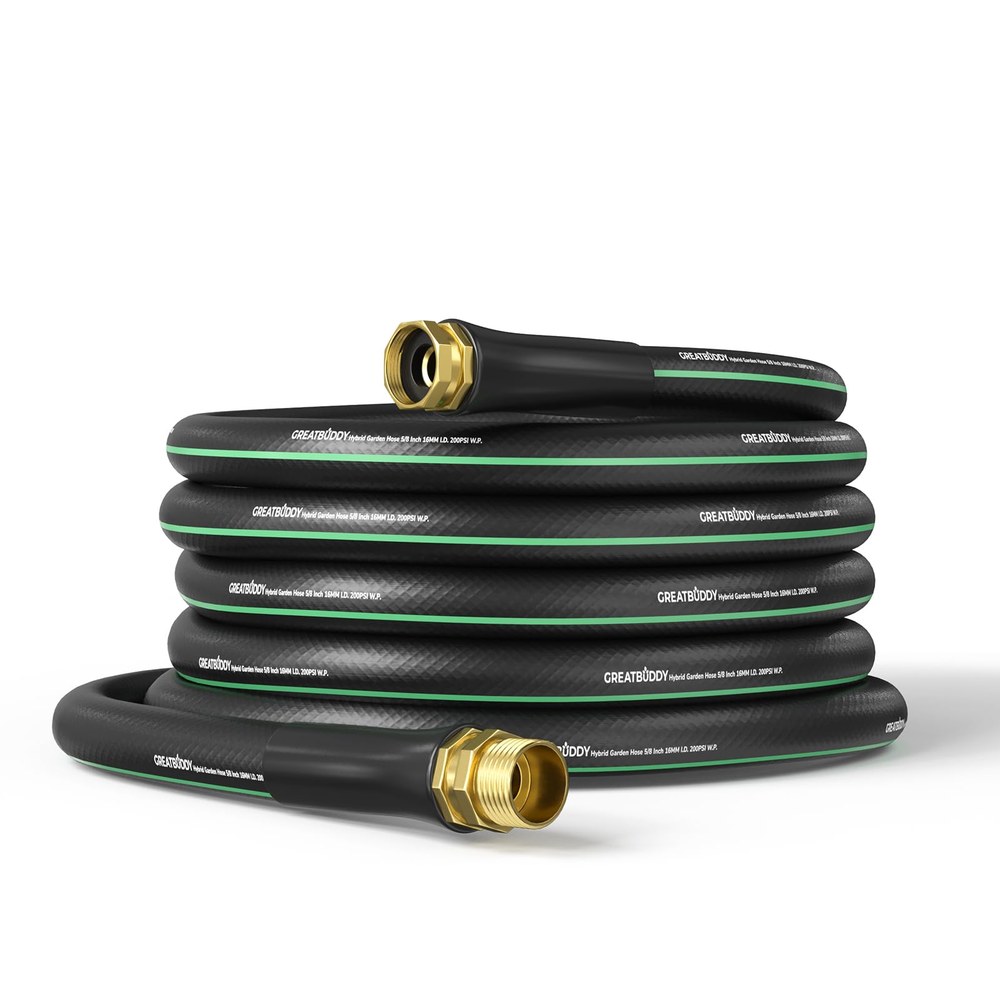
GreatBuddy 50 ft × 5/8 in., flexible rubber hose
Most budget hoses are vinyl, and vinyl is what makes them feel dead in cold weather and crack in the third summer. This one uses a rubber blend at a vinyl price, which is the single most meaningful upgrade a cheap hose can get. It is not as supple as the Flexzilla and its fittings are ordinary, but as a second hose, a back-garden hose, or a first hose you have not yet formed habits around, it is the sensible buy.
What we liked
- Rubber-blend tube instead of vinyl at this price is rare
- Real 5/8” bore, so flow does not embarrass a sprinkler
- Light enough to live with, tough enough to forget about
What we did not
- More coil memory than either hybrid above
- Fittings are functional, not durable — do not overtighten
- Jacket abrasion tolerance is mid-pack
Why hoses kink — it is the reinforcement, not the price tag
A hose is a tube wrapped in reinforcement, and a kink is what happens when the tube collapses where the reinforcement lets it. Vinyl hoses have few reinforcement layers over a soft tube, which is why they kink at the coil. Hybrid polymer hoses use a more tightly woven reinforcement over a stiffer tube: same idea, better geometry, far fewer kinks.
The other half of kinking is memory. A hose left coiled in the sun takes a permanent set along the coil, and that set is a pre-fabricated kink. Whatever hose you buy, uncoil it fully on the first warm day and let it relax in the shade — it straightens the lay and doubles the life of the reinforcement.
Diameter and length decide your flow before the nozzle does
| Setup (at 40 psi spigot) | Flow at the end | Practical result |
|---|---|---|
| 1/2 in. × 50 ft | ~5–6 gpm | Weak sprinklers; slow filling |
| 5/8 in. × 50 ft | ~9–11 gpm | Standard; runs most sprinklers and sprayers |
| 3/4 in. × 50 ft | ~13–17 gpm | Long runs and high-flow sprinklers only |
| 5/8 in. × 100 ft | ~6–8 gpm | Halve the length if you can |
The numbers explain the most common hose mistake: buying 100 feet because the far bed might need it someday. Flow loss scales with length, so a 100-foot 5/8-inch hose behaves like a 50-foot half-inch hose — under-powered everywhere. Buy the length that reaches, and if you must go long, go wide.
Fittings: where hoses actually die
Look at any pile of discarded hoses and you will see mostly intact tubes with ruined ends. The coupling is crimped onto the hose at the factory, and when the crimp deforms — from being driven over, or from being tightened with pliers — the connection weeps. Plastic fittings crack. Steel fittings rust onto the spigot. Brass and machined aluminum both last; the difference is that brass tolerates tools and aluminum does not.
Practical rule: hand-tighten every connection. If a fitting needs a wrench to seal, the washer is worn — replace the ten-cent washer, not the fitting. Overtightening is how good couplings are turned into junk.
Winter is what actually kills hoses
Water expands about nine percent when it freezes. Trapped in a tube, that is a burst hose; trapped in a spigot with a hose still attached, that is a burst pipe inside the wall — which is the one the plumber charges for. Disconnect and drain the hose before the first hard freeze, store it out of UV if you can, and both hose and spigot will outlive the warranty by years.
Frequently asked questions
What hose diameter should I buy?
5/8 inch is the right default. Half-inch loses roughly a third of the flow over the same length, which shows up as a weak sprinkler and a sluggish sprayer. Three-quarter-inch carries more water but is heavier and pricier, and only earns its keep on long runs or high-flow sprinklers.
Do expandable hoses last?
Not as long as conventional hoses, and they fail suddenly rather than gradually. The fabric sleeve protects a thin inner tube; when the tube fails — usually at a fitting or a sharp bend — the hose is finished. Fine for a patio and a watering can; wrong tool for a whole garden.
Why does my hose kink even though it is new?
Reinforcement geometry, not age. Fewer reinforcement layers over a softer tube means the tube collapses at the coil. Warm memory matters too: a hose coiled in the sun takes a set, and the set becomes the kink. Uncoil fully and let it relax in shade before judging it.
Should I disconnect my hose in winter?
Yes, and drain it. Water trapped in an attached hose can back up into the faucet body when it freezes — that is what splits the pipe inside the wall. Five minutes before the first hard freeze prevents the most expensive plumbing failure a garden causes.
The bottom line
Buy 5/8 inch, buy the shortest length that reaches, buy rubber or hybrid polymer rather than vinyl, hand-tighten the fittings, and drain it before winter. A hose cared for that way is a ten-year tool. The same hose left pressurized on a sunny spigot is a two-season purchase.