Affiliate disclosure: As an Amazon Associate, we earn from qualifying purchases. Our rankings here are based on design and published specification, not on laboratory measurement. If you buy through a link on this page we may earn a commission, at no extra cost to you. Read our full disclosure.
Start with the correction that matters: fertilizer is not plant food. Plants make their own food from light, water and air; what we buy are mineral nutrients — mostly nitrogen, phosphorus and potassium — that a plant in the wild would get from decomposing organic matter around its roots. A potted plant cannot go looking for them. We supply them, or growth stalls.
But the way most people supply them causes more damage than supplying nothing at all. Overfeeding kills more houseplants than underfeeding, and the symptoms get misdiagnosed as anything else. So this review is organized around the decision that actually matters: which release curve matches how you will really use it.
The short answer
For containers and garden beds: a water-soluble 20-20-20 fed at half strength on your regular watering schedule through the growing season. For a lower-effort, salt-forgiving approach: a granular organic 4-4-4 scratched into the surface monthly. For houseplants specifically: a dilute liquid feed is fine, but the winning habit is halving whatever the label says.
The three numbers, quickly
| Nutrient | What it drives | Deficiency shows as |
|---|---|---|
| Nitrogen (N) | Leaf and stem growth, chlorophyll | Uniform pale or yellow older leaves; slow growth |
| Phosphorus (P) | Roots, establishment, flowering | Purpling underneath leaves; poor root run |
| Potassium (K) | Water regulation, stress tolerance, tissue quality | Margin scorch on older leaves; weak stems |
Read ratios, not absolutes. A 20-20-20 and a 10-10-10 deliver the same balance of N to P to K — the 20-20-20 just puts more in each gram, which means you dilute it more. What you are choosing between products is the shape of that balance and the form it arrives in.
How we judge
| What we look at | Why it decides the ranking |
|---|---|
| Release curve | Instant, staged or slow — it has to match how often you will actually show up with the watering can |
| Salt load | The thing that burns leaf tips and kills container plants fed full-strength |
| Micronutrients | Iron, magnesium and calcium decide whether a feed works in peat-based potting mix, not just in soil |
| Cost per feeding | Concentrates look expensive until you cost out a season of diluted applications |
| Mixability | Crystal powders that clump into a spoon-wrecking brick fail the real test of a product you use weekly |
The results
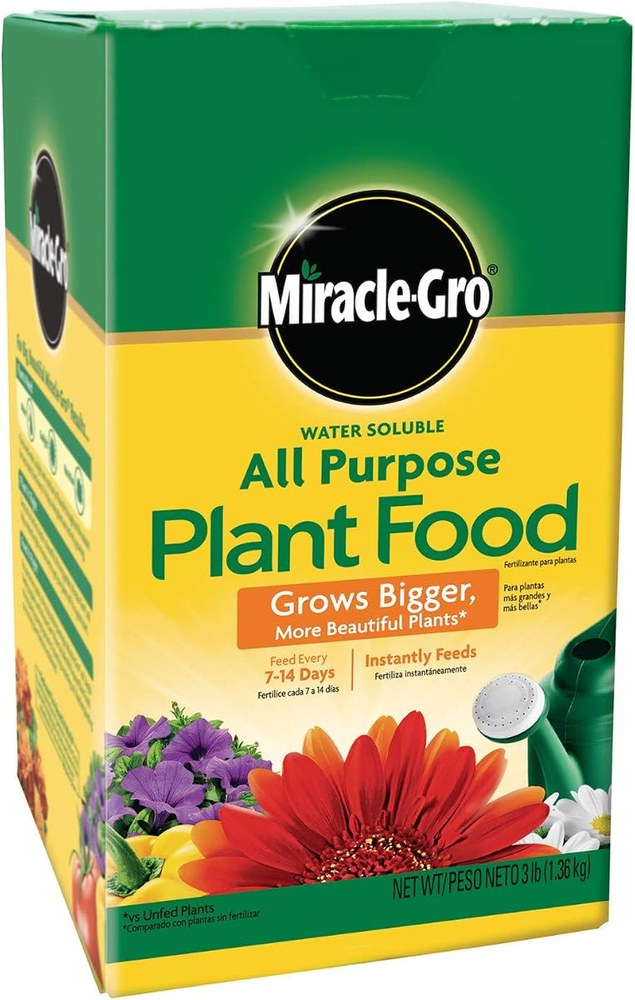
Miracle-Gro Water Soluble All Purpose Plant Food, 3 lb
This is the standard the rest are judged against, and it wins on the property that matters most in a container: instant availability. Dissolved and watered in, the nutrients reach the roots within minutes, which is exactly what a fast-growing tomato or a hungrier annual wants during the July stretch when the potting mix's starter charge is long gone.
The same instant availability is its danger. Feed full strength on a hot dry pot and the salt load hits the root zone at once — the burned-leaf-edge complaint usually traces back here. At half strength on damp soil, it behaves like the gentle weekly feed the label implies. The 3 lb tub makes a season of watering cost pennies per application.
What we liked
- Nutrients available within minutes — the fastest correction for visible deficiency
- Cheapest cost per feeding of any product here
- Micronutrients included, which matters in peat-based potting mixes
What we did not
- Easy to over-apply; the salt load punishes full-strength feeding
- Powder cements into a brick if the tub humidifies — decant into a jar
- Nothing slow about it: miss a week and nothing carries over
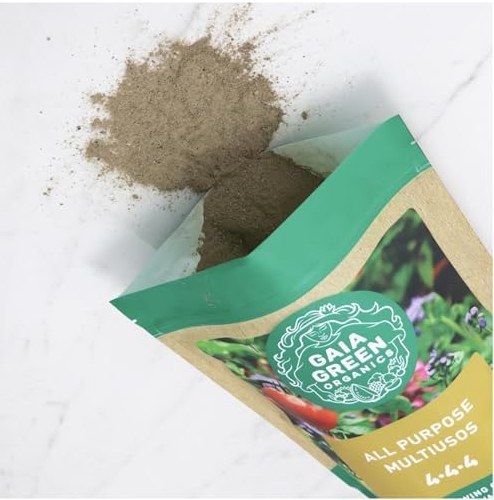
Gaia Green Organic All Purpose Fertilizer 4-4-4, 2 kg
A granular organic is a different product wearing a similar label. The nutrients are bound in bone meal, feather meal, kelp and rock powders; soil microbes release them over weeks. That slowness is the feature: you cannot easily burn a plant with it, and one application per month genuinely covers the interval, where a soluble feed forgets you the moment you do.
The trade is precision and patience. In cold soil the biology is dormant and the feed sits unavailable, so early spring results lag what a soluble product delivers. Scratch it into the surface, water once, and let the system do its work — this is the fertilizer you buy when you want the plant fed on the days you are not thinking about it.
What we liked
- Nearly impossible to over-apply — the forgiving choice for beginners
- One application a month genuinely covers the interval
- Feeds the soil biology, not just the plant
What we did not
- Cold soil delays availability — not a rescue product
- Organic smell; keep the bag sealed
- Cost per pound of actual nutrient is higher than synthetics
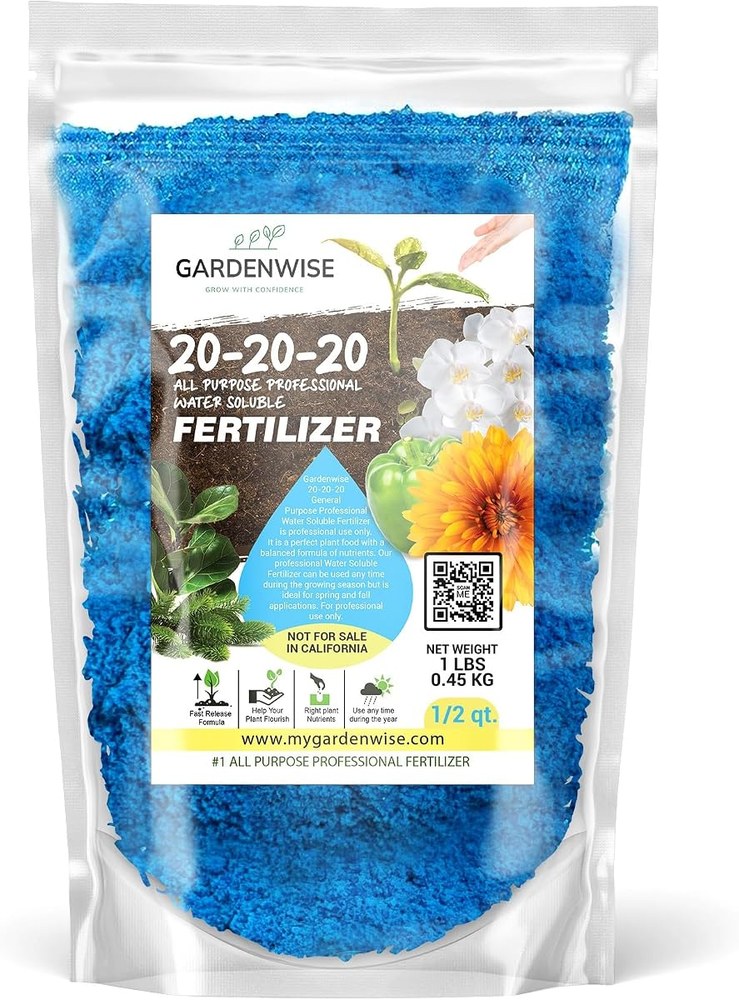
Gardenwise 20-20-20 Water-Soluble Fertilizer Powder
For anyone who has learned the half-strength habit, a straight 20-20-20 is the most flexible tool in the cabinet: the same jug covers houseplants, vegetable starts, and the flower bed, with the dose — not the product — making the difference. Balanced N-P-K plus the micronutrient set that peat-based mixes lack, including the chelated iron that fixes the pale-new-growth look on gardenias and citrus.
Against the Miracle-Gro above it is a calmer formulation — less growth-biased, equally instant, and cheaper per pound. What it lacks is brand ubiquity; if you follow label rates printed for another product, read this one's own label instead.
What we liked
- One balanced formula covers the entire garden and every houseplant
- Micronutrients with chelated iron — fixes pale new growth in peat mixes
- Dissolves completely; no residue in the watering can
What we did not
- Same salt-load rules as any soluble — half strength or burn
- Less familiar label; you must actually read the rates
- Small pouch sizes cost more per pound than the tubs
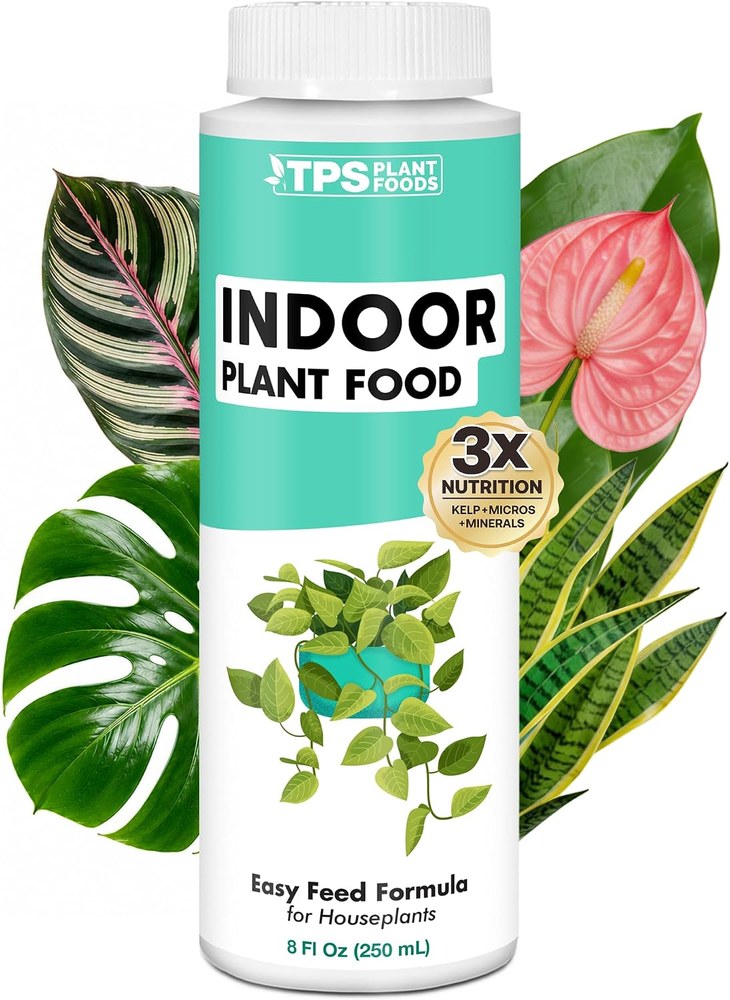
Indoor Plant Food — Complete Liquid Fertilizer, 8 oz
Houseplants are fertilized casually, which is precisely why a pre-diluted liquid with a pump cap wins here: the correct dose is one pump into the watering can, and under-dosing — the safe failure mode — is what happens when you are lazy. The formulation runs gentle enough that weekly use through the growing season does not salt-burn a calathea, which the big soluble brands cannot claim.
Cost per nutrient is the worst of the picks, and a serious collector feeding thirty plants weekly will outgrow the bottle fast. Buy it as the product that makes the habit stick; graduate to a 20-20-20 when the collection, and the discipline, have both grown.
What we liked
- One-pump dosing — the habit that actually happens
- Gentle enough for salt-sensitive foliage plants at weekly use
- Calcium and magnesium included for peat-mix gaps
What we did not
- Highest cost per gram of nutrient here
- 8 oz feeds a serious collection for weeks, not a season
- Pre-diluted means no way to push the dose for hungry plants
Overfeeding: the deficiency that looks like a disease
Every soluble fertilizer is a salt solution. Applied at full strength to a dry root ball in a small pot, it draws water back out of the roots — the same physics as salting a slug — and the plant shows crisp brown leaf margins a few days later. White crust on the soil surface or on the pot rim is the tell: accumulated salts coming out of solution.
The fix costs nothing. Take the plant to a sink and flush plain water through the pot until it runs clear — three or four pot volumes. Then halve the dose and lengthen the interval. Plants recover from feeding damage more readily than from drought, but only if you stop feeding first.
Practical rule: fertilize on damp soil, never on dry. Water first if the pot has dried out, feed later — or just make it half-strength and routine. The label's full rate assumes ideal conditions almost nobody has.
Matching the release curve to your actual behavior
| If you... | Buy | Why |
|---|---|---|
| Water on a schedule and like control | Water-soluble 20-20-20 | Instant, adjustable, cheapest per feed |
| Forget plants exist for weeks at a time | Granular organic 4-4-4 | Slow release covers the gaps you leave |
| Have a windowsill collection of a dozen pots | Pre-diluted liquid | One-pump dosing removes every excuse |
| Are pushing tomatoes in containers | Soluble, growth-leaning (24-8-16) | Heavy feeders in small soil volumes need instant supply |
Frequently asked questions
What does NPK actually mean?
Nitrogen, phosphorus and potassium by weight — the three minerals plants consume most. Nitrogen drives leaves, phosphorus roots and establishment, potassium tissue function and stress tolerance. Ratios matter more than the absolute numbers: 20-20-20 and 10-10-10 are the same balance at different concentrations.
How often should I fertilize houseplants?
Half the label strength on your regular watering schedule through the growing season; quarter or stop in winter when light drops. Full-strength feeding on a calendar schedule is how salt builds up in pots — and most "neglect" damage is actually that.
Why are the tips of my plant's leaves turning brown?
Salt burn or dry air. Salts concentrate at the margins as water evaporates, producing crisp brown edges; a white crust on the pot confirms it. Flush the pot with plain water until it runs clear, then halve the dose and lengthen the interval between feeds.
Is organic fertilizer better than synthetic?
Different tools. Synthetic water-soluble feeds are instant and precise; organic granular feeds are slow, nearly impossible to over-apply, and build soil as they feed. For fast container crops, soluble wins; for beginners, seedlings and salt-sensitive plants, organic is the forgiving default.
The bottom line
Match the form to your behavior, feed at half the label rate on damp soil, and treat brown leaf tips as a salt warning rather than a mystery. A single balanced product, used consistently at the right dose, outperforms a shelf of specialty bottles used impulsively — the NPK label tells you what is in the jug, but the dose tells you what the plant gets.